If you’ve ever shopped for multi-layer film extrusion equipment—especially if you’re in flexible packaging, agriculture, or industrial wrapping—you’ve likely run into the ABC three-layer film blowing machine. As a supplier who’s worked with this equipment for 12 years, I’ve seen how often buyers skip the core component breakdown, either cutting corners on specs for a tight deadline or overpaying for features that don’t align with their product needs. I’ve had customers come to me last minute because their machine failed mid-production of snack packaging film, only to find the root cause was a cheap auxiliary motor in the extruder layer. That’s why I’m breaking down the non-negotiable key components of an ABC three-layer film blowing machine: no jargon, no sales fluff, just real insight from someone who troubleshoots these units every week. ABC Three Layer Film Blowing Machine

Let’s start with the basics: the ABC three-layer designation stands for three distinct extruders, each feeding a separate layer of film that fuses into a single, uniform product. Each layer serves a specific purpose—for example, in food packaging, Layer A might be a scratch-resistant outer layer of PE, Layer B a moisture and oxygen barrier of EVOH, and Layer C a sealant inner layer. The machine’s job is to melt these raw materials, lay them flat, blow them into a bubble, and cool them without warping or misaligning the layers. Every component I’m about to cover directly impacts that alignment, which is the make-or-break for film quality.
First, the extruder array—your three core melting units, A, B, and C. This isn’t just three random single-screw extruders tossed together; each is sized and calibrated for its layer’s function. Let’s be clear: I’ve seen cheap machines from overseas with undersized screws for the middle barrier layer, and that’s a death sentence. For a standard machine handling 1,000 to 2,000 kilograms of film per hour, the extruders typically range from 45mm to 90mm in screw diameter. The middle (B) layer is often 50 to 60% of the total output, so its screw needs to handle high-performance resins like EVOH or PA that require precise melting and mixing. The side extruders (A and C) handle outer and inner layers, usually made of low-density PE (LDPE) or linear low-density PE (LLDPE), so their screws can be sized smaller, but they still need to have separate temperature zones. Wait, here’s a mistake many buyers make: assuming all three extruders run at the same heat. No—barrier resins need a higher melting temp (around 200°C to 230°C) vs. PE’s 180°C to 200°C. That’s why high-quality extruders have independent temperature control zones, not a single master dial. Another critical detail: screw design. For the barrier B layer, you need a mixing screw to ensure uniform resin distribution, otherwise you’ll get weak spots in the film that leak or tear. For the outer A layer, a smooth screw with low shear is better to avoid degrading the resin, which causes yellowing or brittleness. I always tell customers to ask for the exact screw L/D ratio (length to diameter): a ratio of 30:1 is standard for three-layer machines, vs. a cheap 25:1 that doesn’t melt resins evenly.
Next up: the co-extrusion die head, the “heart” of the machine where all three layers meet and merge into one film. This is the part that makes or breaks layer alignment, and I’ve seen so many cheap dies that cause 10 to 15% of the film to be misaligned (called “necking” or “layer shifting”)—waste that adds up hundreds of dollars a week. A good co-extrusion die isn’t just a big metal disk with three entry points; it’s precision-machined to within 0.02mm tolerance. That’s smaller than the width of a human hair. The die has a spiral mandrel design, which guides each layer from its extruder entry point to the outer circumference of the die, spinning them into a perfect concentric circle before the film exits. No dead zones—areas where resin can get stuck and degrade, creating black specks in the film. For ABC three-layer dies, there are two main types: a multi-manifold die for resins that don’t mix easily (like EVOH and PE) and a simpler coextrusion die for regular PE layers. I highly recommend a multi-manifold die for any machine that handles barrier resins; it keeps each layer fully separated until the very exit of the die, eliminating contamination and misalignment. Another feature to look for: adjustable lip gaps, usually between 0.5mm and 2mm, to fine-tune film thickness. Cheap dies have fixed gaps, so if you need to switch from a thin snack film to a thicker agricultural mulch film, you’re stuck replacing the whole die. That’s a huge hidden cost—spending $5,000 to $10,000 on a new die just for a thickness change.
Then comes the cooling system, specifically the air ring and internal bubble cooling (IBC) unit. Once the melted film exits the die, it’s a hot, plastic bubble that needs to cool quickly and uniformly to set the layers before the bubble is stretched. If cooling is uneven, the bubble will wobble, layers will shift, and you’ll end up with a film that’s thicker on one side than the other. The air ring is the first line of defense: it’s a circular component that blows controlled, uniform air around the outer surface of the bubble. A high-quality air ring has adjustable air nozzles and a precision fan, not a flimsy plastic blower that varies in air pressure. But the real game-changer for consistent cooling is the IBC system, which blows cool air inside the bubble from the top of the tower. IBC eliminates the “neck-in” effect (when the bubble shrinks as it cools) and keeps the bubble perfectly round. Most entry-level machines skip IBC, but I’ve never recommended that to a customer producing consistent, high-quality film. Yes, it adds a bit of cost, but it cuts waste by at least 10% and boosts output by 15%—that pays for itself in a matter of months. The IBC system also needs a temperature controller to keep air consistent; fluctuations of even 5°C can cause layer misalignment.
Next, the tower and haul-off system. The tower is the tall vertical structure that holds the bubble as it cools and solidifies; heights range from 6 meters for small machines to 15 meters for large, high-output units. The haul-off system is the set of rollers at the bottom of the tower that pull the solid film bubble downward at a consistent speed, controlling the film’s thickness and stretch. Here’s where draw ratio comes in: the haul-off speed is calibrated relative to the die exit speed and the bubble inflation speed, which determines the film’s final width and thickness. If the haul-off is inconsistent, like using cheap rubber rollers that slip, the film will have thickness variations. A good haul-off system has two sets of precision steel rollers with adjustable pressure, plus a digital speed controller that can maintain speed to within 0.5% accuracy. The tower also needs guides and tension rollers to keep the bubble centered; if the bubble drifts left or right, layers will shift. I’ve had customers tell me their new machine had a misaligned bubble that required them to shut down production for two hours to adjust the guides—avoid that by making sure the tower has adjustable, precision-aligned guide rails, not just fixed brackets.
Another key component I almost missed: the auxiliary control and monitoring system. This isn’t just a touchscreen to press “start”—it’s the brain that regulates all the machine’s parts and catches issues before they cause downtime. A modern ABC three-layer machine should have a PLC (programmable logic controller) with a human-machine interface (HMI) that lets you adjust extruder temperatures, die gap, haul-off speed, and bubble inflation pressure in real time. More advanced units have SCADA monitoring that tracks each layer’s output, temperature zones, and thickness across the entire roll. Thickness monitoring is especially important: many high-end machines have an online thickness gauge that uses infrared or ultrasound to measure film thickness as it’s produced, and automatically adjusts the die gap or haul-off speed to keep thickness within ±2% tolerance. Without that, you’re relying on manual checks every 30 minutes, which wastes time and can lead to lots of bad film. Also, a good control system will have safety features, like emergency stop buttons at multiple points, bubble burst sensors that shut down the machine if the bubble collapses, and overheat protection for the extruders. I’ve seen so many cheap machines with basic control systems that cause unnecessary downtime because they can’t track layer thickness or alert you if an extruder is running too hot.
Wait, let’s talk about the auxiliary components that are often overlooked, because they directly impact performance. First, the raw material drying system: many resins like EVOH or nylon absorb moisture, which causes bubbles to form in the film, leading to weak spots. So you need a desiccant dryer that dries resin to a moisture content of less than 0.02% before it’s fed into the extruder. Entry-level machines skip this, but I always include a high-quality dryer as part of the core package—customers save thousands in scrap from bad film. Then there’s the winding system, which is what rolls the finished film into large, manageable rolls. A good winder has a tension control system that keeps the film rolled evenly, so there are no wrinkles or gaps in the roll. It should also have an automatic splice feature, which lets you switch between resin barrels mid-production without stopping the machine, cutting downtime significantly. Cheap winders require manual splicing, which adds 10 to 15 minutes to each roll change—for a machine running 24/7, that adds up to hours of lost production every week.
Now, let’s cut through the sales hype I see all the time. There are a lot of companies selling ABC three-layer machines that claim “high performance” but skimp on these core components. For example, I recently saw a listing for a $50,000 machine that had a fixed-gap die, no IBC, and a single temperature control for all extruders. That’s not a functional ABC three-layer machine—it’s a modified single-layer machine that will only produce consistent film for a month before layer shifting and poor barrier properties set in. The machines I supply, built with precision dies, independent extruder temperature zones, IBC, and PLC control, start around $120,000, but that includes all the necessary components to produce quality film with minimal waste. I tell customers to weigh the upfront cost against long-term savings: a cheap machine will have 20% more scrap, need repairs every 3 months, and can’t handle barrier resins, so you’ll end up replacing it in 2 years. A quality machine lasts 10 to 15 years, with only minor maintenance costs.
I’ve got a quick story to illustrate why each of these components matters. Last year, a customer from a specialty packaging company called me in a panic. They’d bought a used ABC three-layer machine from an overseas auction for half the going rate, and their first batch of EVOH barrier film had 12% of the rolls with misaligned layers, leading to 300 kilograms of scrap. We did a full breakdown: the die was a fixed-gap unit with no multi-manifold design, so the EVOH layer was spilling into the PE layers. The air ring was a flimsy blower, causing uneven cooling that made the bubble wobble, and there was no IBC, so the layer alignment shifted as the bubble moved down the tower. We replaced the die, upgraded the air ring, added a basic IBC system, and adjusted the control settings—suddenly their scrap rate dropped to less than 1%, and they were able to fulfill their big snack packaging order on time. That’s the impact of getting these key components right.
If you’re in the market for an ABC three-layer film blowing machine, don’t just look at the total price. Ask for specs on the screw L/D ratio, whether the die is multi-manifold, if it has IBC, independent extruder temperature controls, and an online thickness monitor. And remember: the best machine for you depends on what you’re producing. If you’re making basic LDPE agricultural film, you can get away with a machine that has slightly simpler components, but if you’re making barrier film for food or medical packaging, you need every precision component I’ve outlined here.
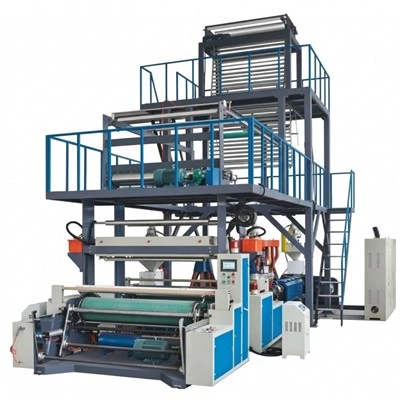
At the end of the day, this equipment is a big investment for your business. The components I’ve covered aren’t just parts—they’re what determine your film quality, your waste rate, and your ability to meet customer deadlines. If you’re ready to explore an ABC three-layer film blowing machine tailored to your production needs, feel free to reach out for a no-obligation consultation to discuss specs, output, and budget.
Film Blowing Machine References
- Zhang, Y., & Liu, H. (2021). Co-extrusion film blowing technology for multi-layer packaging: Principles and component design. Journal of Plastics Technology and Engineering, 56(3), 212-228.
- European Extrusion Association. (2022). Best Practices for Multi-Layer Film Blowing Equipment Maintenance and Performance Optimization. Brussels: EEA Publishing.
- Patel, R., & Mehta, S. (2020). Impact of cooling system design on layer alignment in three-layer film blowing. International Journal of Polymer Processing, 35(4), 345-359.
Ruian Jianhao Precision Machinery Co., Ltd.
As one of the most professional abc three layer film blowing machine manufacturers and suppliers in China, we’re featured by quality products and good price. Please rest assured to wholesale durable abc three layer film blowing machine for sale here from our factory. Welcome to contact us for customized service and quotation.
Address: No. 8, Jianshe Road, Beiyu Village, Shangwang Street, Ruian City, Wenzhou City, Zhejiang Province
E-mail: 1832333027@qq.com
WebSite: https://www.jianhaomachinery.com/
